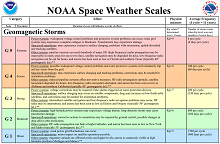

Communicating with server...
Having SatCom problems?
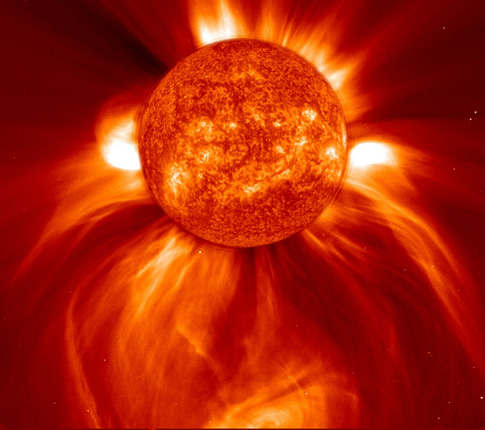
A burst of radiation on the sun's surface may trigger a geomagnetic storm, which can disrupt satellite communications.
In order to prevent unnecessary maintenance on satellite communications systems Air Sat One has provided a feed of Geophysical Events from NOAA's Space Weather Prediction Center. Check here to see if solar activity could be a cause of satellite communications problems.
Geophysical Alert Message Issued: Sep 29th, 2026 11:39:25 pm
Space Weather Message Code: ALTTP4
- Serial Number: 718
- Issue Time: 2026 Sep 30 0339 UTC
- ALERT: Type IV Radio Emission
- Begin Time: 2026 Sep 30 0256 UTC
- Comment: Observed by PAL
Geophysical Alert Message Issued: Sep 29th, 2026 9:01:59 am
Space Weather Message Code: WATA20
- Serial Number: 1127
- Issue Time: 2026 Sep 29 1301 UTC
- WATCH: Geomagnetic Storm Category G1 Predicted
- Highest Storm Level Predicted by Day:
- Sep 30: None (Below G1) Oct 01: None (Below G1) Oct 02: G1 (Minor)
- THIS SUPERSEDES ANY/ALL PRIOR WATCHES IN EFFECT
- Comment: 28 Sep CME inbound
- NOAA Space Weather Scale descriptions can be found at
- www.swpc.noaa.gov/noaa-scales-explanation
- Potential Impacts: Area of impact primarily poleward of 60 degrees Geomagnetic Latitude.
- Induced Currents - Weak power grid fluctuations can occur.
- Spacecraft - Minor impact on satellite operations possible.
- Aurora - Aurora may be visible at high latitudes, i.e., northern tier of the U.S. such as northern Michigan and Maine.
Geophysical Alert Message Issued: Sep 29th, 2026 1:02:02 am
Space Weather Message Code: ALTEF3
- Serial Number: 3748
- Issue Time: 2026 Sep 29 0502 UTC
- CONTINUED ALERT: Electron 2MeV Integral Flux exceeded 1,000pfu
- Continuation of Serial Number: 3747
- Begin Time: 2026 Sep 26 1535 UTC
- Yesterday Maximum 2MeV Flux: 4128 pfu
- Max time: 2026 Sep 28 1440 UTC
Geophysical Alert Message Issued: Sep 28th, 2026 1:00:40 am
Space Weather Message Code: ALTEF3
- Serial Number: 3747
- Issue Time: 2026 Sep 28 0500 UTC
- CONTINUED ALERT: Electron 2MeV Integral Flux exceeded 1,000pfu
- Continuation of Serial Number: 3746
- Begin Time: 2026 Sep 26 1535 UTC
- Yesterday Maximum 2MeV Flux: 3060 pfu
- Max time: 2026 Sep 27 1720 UTC
Geophysical Alert Message Issued: Sep 27th, 2026 1:02:04 am
Space Weather Message Code: ALTEF3
- Serial Number: 3746
- Issue Time: 2026 Sep 27 0502 UTC
- CONTINUED ALERT: Electron 2MeV Integral Flux exceeded 1,000pfu
- Continuation of Serial Number: 3745
- Begin Time: 2026 Sep 26 1535 UTC
- Yesterday Maximum 2MeV Flux: 1260 pfu
- Max time: 2026 Sep 26 1645 UTC
Geophysical Alert Message Issued: Sep 26th, 2026 8:40:33 pm
Space Weather Message Code: ALTK04
- Serial Number: 2688
- Issue Time: 2026 Sep 27 0040 UTC
- ALERT: Geomagnetic K-index of 4
- Threshold Reached: 2026 Sep 27 0040 UTC
- Synoptic Period: 0000-0300
- Active Warning: YES
- Comment:
- NOAA Space Weather Scale descriptions can be found at
- www.swpc.noaa.gov/noaa-scales-explanation
- Potential Impacts: Area of impact primarily poleward of 65 degrees Geomagnetic Latitude.
- Induced Currents - Weak power grid fluctuations can occur.
- Aurora - Aurora may be visible at high latitudes such as Canada and Alaska.
Geophysical Alert Message Issued: Sep 26th, 2026 8:35:26 pm
Space Weather Message Code: WARK04
- Serial Number: 5423
- Issue Time: 2026 Sep 27 0035 UTC
- WARNING: Geomagnetic K-index of 4 expected
- Valid From: 2026 Sep 27 0033 UTC
- Valid To: 2026 Sep 27 1200 UTC
- Warning Conditions: Onset
- Comment:
- NOAA Space Weather Scale descriptions can be found at
- www.swpc.noaa.gov/noaa-scales-explanation
- Potential Impacts: Area of impact primarily poleward of 65 degrees Geomagnetic Latitude.
- Induced Currents - Weak power grid fluctuations can occur.
- Aurora - Aurora may be visible at high latitudes such as Canada and Alaska.
Geophysical Alert Message Issued: Sep 26th, 2026 11:51:34 am
Space Weather Message Code: ALTEF3
- Serial Number: 3745
- Issue Time: 2026 Sep 26 1551 UTC
- ALERT: Electron 2MeV Integral Flux exceeded 1,000pfu
- Threshold Reached: 2026 Sep 26 1535 UTC
- Station: GOES-19
- Comment:
Geophysical Alert Message Issued: Sep 25th, 2026 5:55:03 pm
Space Weather Message Code: WARK04
- Serial Number: 5422
- Issue Time: 2026 Sep 25 2155 UTC
- WARNING: Geomagnetic K-index of 4 expected
- Valid From: 2026 Sep 25 2154 UTC
- Valid To: 2026 Sep 26 1200 UTC
- Warning Conditions: Onset
- Comment:
- NOAA Space Weather Scale descriptions can be found at
- www.swpc.noaa.gov/noaa-scales-explanation
- Potential Impacts: Area of impact primarily poleward of 65 degrees Geomagnetic Latitude.
- Induced Currents - Weak power grid fluctuations can occur.
- Aurora - Aurora may be visible at high latitudes such as Canada and Alaska.
Geophysical Alert Message Issued: Sep 25th, 2026 5:58:25 pm
Space Weather Message Code: ALTK04
- Serial Number: 2687
- Issue Time: 2026 Sep 25 2158 UTC
- ALERT: Geomagnetic K-index of 4
- Threshold Reached: 2026 Sep 25 2158 UTC
- Synoptic Period: 2100-2400
- Active Warning: YES
- Comment:
- NOAA Space Weather Scale descriptions can be found at
- www.swpc.noaa.gov/noaa-scales-explanation
- Potential Impacts: Area of impact primarily poleward of 65 degrees Geomagnetic Latitude.
- Induced Currents - Weak power grid fluctuations can occur.
- Aurora - Aurora may be visible at high latitudes such as Canada and Alaska.